










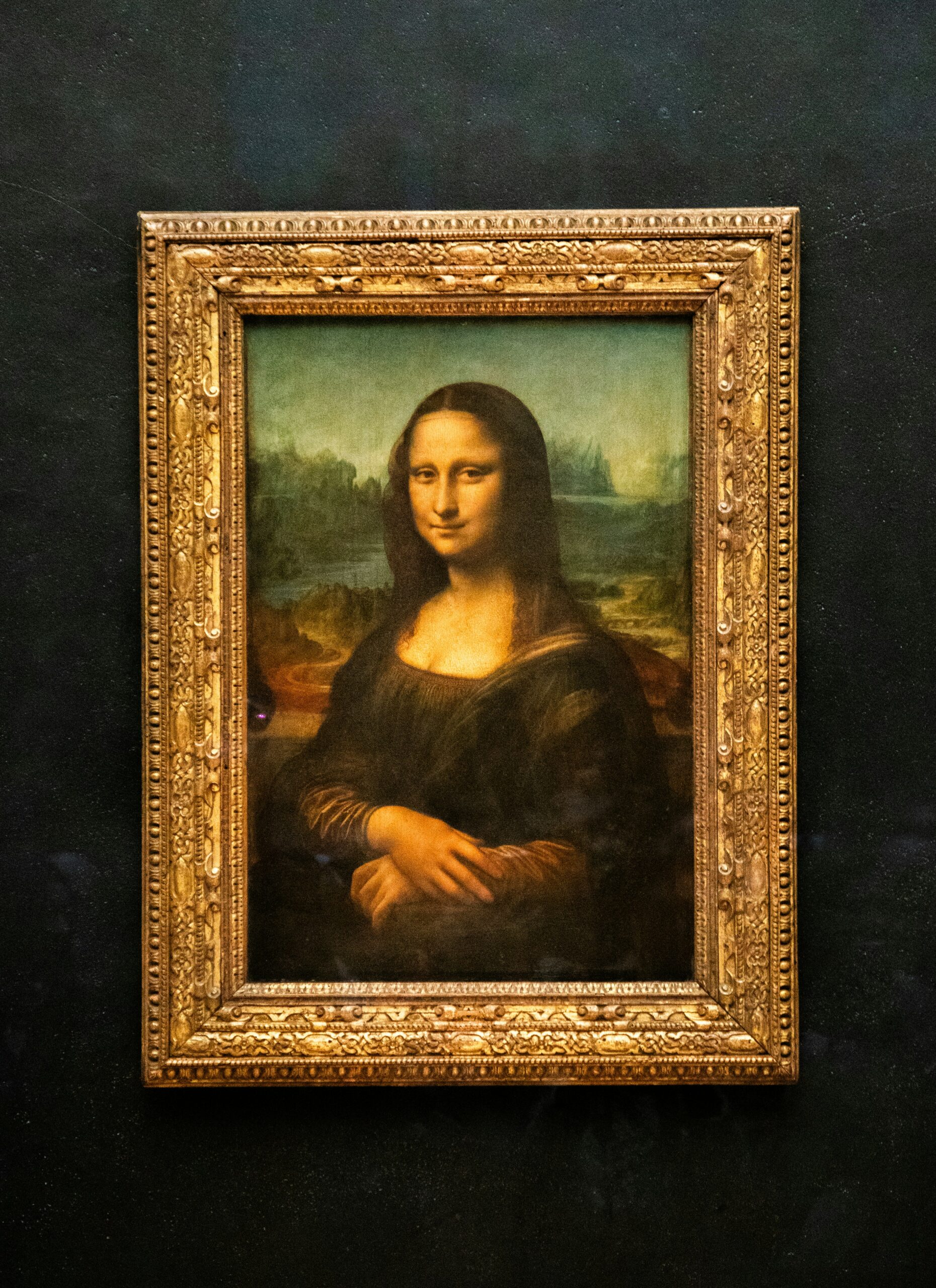
The Mona Lisa, painted by Leonardo da Vinci between 1503 and 1506 (with possible later revisions), is arguably the most renowned portrait in art history. Housed in the Louvre Museum in Paris, this painting transcends its medium, embodying the intellectual spirit of the Renaissance, the evolution of humanist aesthetics, and the enduring fascination with psychological realism. This paper examines the Mona Lisa through an interdisciplinary lens—addressing its historical context, artistic innovations, semiotic layers, conservation history, and global cultural impact.
The Mona Lisa (La Gioconda in Italian, La Joconde in French) represents not merely an artistic triumph but a cultural phenomenon that encapsulates centuries of fascination and scholarly debate. Commissioned by Francesco del Giocondo, a Florentine merchant, the portrait is believed to depict his wife, Lisa Gherardini (Zöllner & Nathan, 2017). Today, the painting stands as a symbol of the Renaissance ideal of balanced composition, technical precision, and psychological depth.
The painting’s status is such that its artistic merits are often eclipsed by its own fame, a condition art historian Hans Belting termed “the tyranny of the masterpiece.” This research seeks to peel back these layers of reception to engage with the work on three distinct levels:
- As a Technical Artifact: The product of Leonardo’s scientific curiosity and painterly innovation.
- As a Historical Document: A portrait embedded in the social and commercial world of 16th-century Florence.
- As a Cultural Construct: An icon whose meaning has been shaped by theft, reproduction, and its status as a tourist attraction.
Historical and Cultural Context
Leonardo da Vinci painted the Mona Lisa during his tenure in Florence, a period characterized by rapid artistic and intellectual transformation. The early 16th century marked a shift toward humanism, emphasizing the individual as the central subject of study and expression (Kemp, 2006). Within this milieu, portraiture evolved beyond decorative or representational forms to explore inner emotion and intellect.
Leonardo, both scientist and artist, was deeply invested in anatomy, optics, and human psychology—all of which inform the lifelike yet enigmatic quality of the Mona Lisa. His notebooks reveal meticulous studies of the muscles governing facial expression, underscoring his desire to capture moto dell’anima—the movement of the soul (Capra, 2007).
Deconstructing Leonardo’s Technique: The Science of Sfumato
The Mona Lisa’s aesthetic power is not an accident of mystery but the direct result of Leonardo’s methodical, scientific approach to painting. His technique can be broken down into several groundbreaking elements:

1. Sfumato:
Meaning “gone up in smoke,” sfumato is the meticulous layering of ultra-thin glazes to eliminate harsh lines and create seamless transitions between light and shadow. Recent scientific analyses, including X-ray fluorescence and infrared reflectography, have revealed:
- A base layer of lead white to enhance luminosity.
- Dozens of layers of glaze, some only one or two micrometers thick, containing linseed oil and muted pigments.
- The absence of any visible brushstrokes, creating a hazy, atmospheric effect that makes the figure appear to breathe.
2. The Pyramid Composition & Atmospheric Perspective:
Leonardo organized the figure into a stable, pyramidal structure, creating a sense of monumental calm. The distant, dreamlike landscape, with its blues and muted tones, is a masterful application of aerial perspective, demonstrating his understanding of optics and the scattering of light.
3. The Smile: A Neurological and Artistic Feat:
The famous smile operates through Leonardo’s exploitation of the human visual system. He painted the smile predominantly using low spatial frequencies, which are best perceived by our peripheral vision. When a viewer looks directly at the mouth, the smile appears to vanish, only to reappear when gazing at the eyes or the background. This creates a dynamic, living expression.
Perhaps no aspect of the Mona Lisa has inspired more discourse than her elusive smile. Cognitive scientists have proposed that the perception of her expression changes depending on the viewer’s angle and visual focus, an effect attributed to Leonardo’s understanding of human visual perception (Livingstone, 2000). The smile thus becomes a study in ambiguity—simultaneously present and absent, cheerful and reserved—mirroring the Renaissance fascination with duality and illusion.
Material History & Condition: The Painting as a Physical Object
The Mona Lisa we see today is a fragile artifact that has undergone significant physical change:
- Support: Painted on a thin poplar wood panel, prone to warping. A crack runs vertically through the top of the panel.
- Varnish: The aged, yellowed varnish, applied in previous centuries for protection, has dramatically darkened the background and altered the original color balance.
- Losses: The painting was originally equipped with side columns and a slightly different aspect ratio. It has also been trimmed slightly on both sides.
- Conservation: It is now housed in a climate-controlled, bulletproof case filled with inert gas to prevent further deterioration.
The Making of an Icon: Theft, Media, and the Museum
The Mona Lisa was a respected work within the Louvre but did not achieve global superstardom until the 20th century. This transformation was catalyzed by a single event:
The Theft of 1911:
In 1911, Vincenzo Peruggia, an Italian patriot and former Louvre employee, stole the painting by hiding it in his smock. The two-year absence from the Louvre created a media frenzy. Newspapers worldwide ran the story, and the public lined up to see the empty space on the wall. Upon its recovery, the Mona Lisa was no longer just a painting; it was a celebrity.
Mass Reproduction and Pop Culture:
The image was perfectly suited for the age of mechanical reproduction. It became a staple of postcards, advertisements, and later, internet memes. Marcel Duchamp’s L.H.O.O.Q. (1919), a postcard of the Mona Lisa with a mustache, epitomized the modern urge to both venerate and desecrate the icon. This process democratized and simultaneously trivialized the image, embedding it deep within the global psyche.
The Louvre as a Pilgrimage Site:
Today, viewing the Mona Lisa is a ritual defined by its difficulty. The small painting is besieged by crowds, protected by barriers and glass. The experience, often mediated through smartphone screens, is less about aesthetic contemplation and more about participating in a cultural ritual—a pilgrimage to the altar of high art.

Recent analyses, such as a 2024 Scientific Reports study, attribute the smile’s oscillation between melancholy and joy to psychological ambiguity, while 2025 examinations of toxic pigments (e.g., arsenic-based greens) illuminate Leonardo’s experimental palette. Golden ratio spirals and triangles further underscore mathematical precision, though their intentionality remains debated.
| Technique | Description | Renaissance Innovation |
|---|---|---|
| Sfumato | Soft tonal transitions without outlines | Blurs boundaries between figure and space, enhancing realism |
| Aerial Perspective | Hazy distant landscape | First major use in Italian portraiture, linking sitter to cosmos |
| Three-Quarter View | Near-frontal gaze with folded hands | Shifts from profile busts, influencing Raphael and Titian |
| Oil Glazes | Multiple thin layers on poplar | Allows subtle reworking and luminosity |
Provenance and Conservation
The Mona Lisa was brought to France by Leonardo himself when he entered the service of King Francis I around 1516. Since then, it has remained in France, becoming royal property and eventually a centerpiece of the Louvre Museum after the French Revolution.
Throughout history, the painting has endured theft, vandalism, and restoration efforts. The 1911 theft by Vincenzo Peruggia, who believed the painting should return to Italy, paradoxically enhanced its fame worldwide (Hoobler & Hoobler, 2006). Today, the Mona Lisa is displayed behind bulletproof glass under strict climate control, a testament to both its fragility and its global significance.
Global Cultural Impact
Beyond its artistic legacy, the Mona Lisa functions as a cultural touchstone and symbol of artistic perfection. It has been reinterpreted and parodied across media—from Marcel Duchamp’s L.H.O.O.Q. (1919) to contemporary digital culture—highlighting its semiotic versatility as both sacred object and pop icon (Eco, 1986).

Its mass reproduction, commercial use, and digital circulation reflect a modern paradox: while the Mona Lisa epitomizes individuality and craftsmanship, it also embodies the global commodification of art. This duality reinforces Walter Benjamin’s notion of the “aura” of artwork in the age of mechanical reproduction (Benjamin, 1936).
Final Verdict
The Mona Lisa endures as more than a portrait; it is a philosophical artifact bridging art, science, and human emotion. Leonardo’s synthesis of technical innovation and psychological nuance established a new paradigm for artistic expression—one that continues to influence visual culture and theoretical discourse.
he Mona Lisa is a deeply complex object. It is a sublime technical achievement that marks the apex of Renaissance humanism, a fragile physical Artifact bearing the scars of time, and a powerful cultural symbol whose meaning is perpetually negotiated. To study it is to study not only Leonardo da Vinci’s genius but also the history of taste, the power of media, and the politics of display. Her enigmatic presence invites perpetual reinterpretation, ensuring that the Mona Lisa remains not only a masterpiece of the Renaissance but also a living participant in the ongoing dialogue between viewer, artist, and time.
References (APA 7th Edition)
- Benjamin, W. (1936). The Work of Art in the Age of Mechanical Reproduction.
- Capra, F. (2007). The Science of Leonardo: Inside the Mind of the Great Genius of the Renaissance. Doubleday.
- Eco, U. (1986). Travels in Hyperreality. Harcourt Brace Jovanovich.
- Hoobler, D., & Hoobler, T. (2006). The Crimes of Paris: A True Story of Murder, Theft, and Detection. Little, Brown.
- Kemp, M. (2006). Leonardo da Vinci: The Marvellous Works of Nature and Man. Oxford University Press.
- Livingstone, M. S. (2000). Vision and Art: The Biology of Seeing. Abrams.
- Zöllner, F., & Nathan, J. (2017). Leonardo da Vinci: The Complete Paintings and Drawings. Taschen.
- Belting, Hans. The Invisible Masterpiece. University of Chicago Press, 2001.
- Sassoon, Donald. Becoming Mona Lisa: The Making of a Global Icon. Harcourt, 2001.
- Kemp, Martin. Leonardo da Vinci: The Marvellous Works of Nature and Man. Oxford University Press, 2007.
- Mohen, Jean-Pierre, et al. Mona Lisa: Inside the Painting. Harry N. Abrams, 2006.
- Vasari, Giorgio. The Lives of the Artists. Oxford World’s Classics, 2008.
- Zöllner, Frank. Leonardo da Vinci: The Complete Paintings and Drawings. Taschen, 2020.
- “Scientific Analysis of the Mona Lisa.” Louvre Museum Technical Reports, 2022.
- “The Theft that Made the Mona Lisa Famous.” Smithsonian Magazine, 2021.